
Welcome to WordPress. This is your first post. Edit or delete it, then start writing!
209Stillwater Stargazers
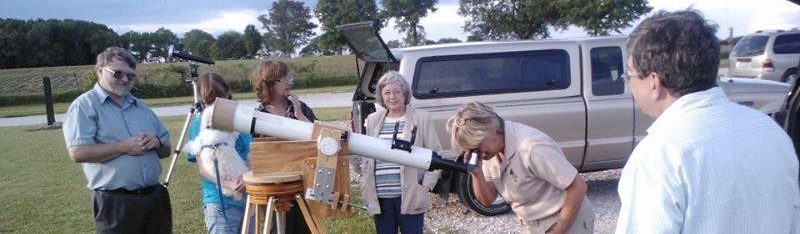
We are astronomers in the Troy, Ohio area.
5 days ago
Last Friday we announced our new partnership with The Moeller Observatory. Today we have another big announcement. ALCON 2026 is coming to Cincinnati.The Cincinnati Astronomical Society announces ALCON 2026, the nation’s premiere amateur astronomy conference, is coming to Cincinnati August 12-15 2026. This is the first time in over 25 years this conference has been held in the Midwest.
Hosted by the Cincinnati Astronomical Society (CAS) in cooperation with The Astronomical League (astroleague.org), ALCON 2026 will bring nationally recognized and regional speakers to The Cincinnati Marriott at Rivercenter this August.
Three days of presentations, happy hours, social events, tours, and the annual StarBQ at The Cincinnati Museum Center will fill the schedule of this fun and dynamic conference.
As a bonus, this year we add an additional event, an afterparty at The Moeller Observatory in Adams County, Ohio on Sunday August 16th. CAS recently announced their partnership with the new research-class astronomy facility, and this will be an opportunity for ALCON 2026 attendees to visit this new and exciting astronomy complex.
Registration is open now. Learn more at ALCON2026.org and register today. ... See MoreSee Less
1 week ago
By now everyone has seen the beautiful image NASA released of Earth taken by Artemis II astronaut Reid Wiseman. But let’s take a closer look at this now iconic image to understand it a little bit better.One thing most people have noticed right away is there are stars in the background, which you typically don’t see in a lot of space images, and is also at the core of many conspiracy theorists arguments about images being fake. So why does this image show stars?
The answer is told by looking at the original image by Reid, which is available from NASA (link below). This released image has been adjusted to bring out details. The Artemis astronauts are taking photos with Nikon Z9 mirrorless cameras and Nikon D5 DSLRs. They do have their iPhones with them as well but it’s unlikely this image was taken with a phone.
The reason is two-fold. The resolution of the image is very high, and also because of what they did with it in post processing. This image was likely taken using the RAW setting which is what most pro photographers use rather than JPEG. RAW gives the photographer the ability to do a lot of adjustments in post-processing unavailable when shooting in other formats. One of those adjustments is to push underexposed areas to appear much brighter. This does come at a cost as this usually results in the image being noisy or grainy, which is what we see in this image.
This image is actually of the night time side of Earth (see original in the comments) adjusted to look more like daytime. We can tell because you see the thin sliver of sunlight on the rim of the Earth on the right edge. You can also make out city lights emitted from some of the larger cities on the surface. We’ll add an annotated version below in the comments.
The Earth is “upside down” in this image so to speak, with the Western half of Africa in the lower left quadrant. You can see Spain and the Iberian peninsula to the lower left near the edge, and the Strait of Gibraltar between them. Appearing faintly over to the right, is South America. Unseen in this image is most of Europe, Asia, or North America, because the Earth is a sphere.
You can also see greenish aurora on the South Pole (at the top right) and the North Pole (at the bottom left), and the bright point of light is Venus.
For more photos directly from NASA in all resolutions visit:
images.nasa.gov/
Earth image: Reid Wiseman ... See MoreSee Less
7 months ago
www.facebook.com/share/p/14PBsUFx52i/We may be living inside one of the largest known voids in the universe.Astronomers have long puzzled over the “Hubble Tension” – the fact that the universe appears to expand at different rates depending on how you measure it. Distant light from the early universe suggests a slower expansion, while local measurements from supernovae and Cepheid stars show a faster one.
Now, a study supports a striking possibility: Earth may be inside a 2-billion-light-year-wide void – a cosmic underdensity known as the KBC supervoid – and it might be distorting our measurements of the universe itself.
Here’s how it works: In standard cosmology, the universe is assumed to be roughly uniform on large scales – with galaxies, dark matter, and gas evenly spread. But the KBC supervoid violates that assumption. It’s an enormous region with fewer galaxies and less matter than average.
Light traveling from distant galaxies toward us passes through this low-density region. As it does, the gravitational influence of the void causes subtle changes in how the light stretches – an effect known as the Integrated Sachs-Wolfe effect. That stretch can make galaxies seem like they’re moving away from us faster than they are, skewing local estimates of the Hubble constant upward.
This might explain why local measurements show ~45 miles per second per megaparsec (73 km/s/Mpc), while early-universe data points to ~42 (67 km/s/Mpc).
But the implications go deeper.
According to the standard ΛCDM model – which includes dark energy and cold dark matter – a void this large and empty shouldn’t exist. That has led some researchers to explore alternative theories like Modified Newtonian Dynamics (MOND), which tweaks gravity instead of invoking invisible dark matter.
If confirmed, the KBC supervoid would be more than just a cosmic curiosity. It would mean our measurements of the universe’s expansion – and possibly even our theories of gravity – need a second look.
Read the study:
"A simultaneous solution to the Hubble tension and observed bulk flow within 250 h−1 Mpc." Monthly Notices of the Royal Astronomical Society, 2024. ... See MoreSee Less
10 months ago
Europe has levelled a mountain to build $1,000,000,000 telescope that will become largest optical telescope on Earth ... See MoreSee Lesswww.uniladtech.com
Multiple European nations have come together to build the largest optical telescope on Earth but it'll cost $1,000,000,000 and they have to level a mountain1 years ago
www.msn.com/en-us/news/technology/basics-of-astrophotography-everything-you-need-to-know-to-take-... ... See MoreSee LessBasics of Astrophotography | Everything You Need To Know To Take Your First Night Sky Photos, TODAY
www.msn.com
Photographing the Milky Way: a rite of passage for every landscape photographer, and truly the pinnacle of capturing the beauty of our planet. It doesn't have to be scary, and it certainly doesn't hav...
